Flying Safaris vs. Overland Drives: Choosing the Right Transport; The choice between flying and driving between destinations shapes your entire East Africa trip more than most travelers initially expect, affecting not just cost and comfort but the actual character of your journey.
Overland drives cover more ground, cost less, and deliver scenery you’d otherwise miss entirely. Flying safaris trade that immersion for speed, comfort, and access to remote areas that overland travel simply can’t reach efficiently. This guide breaks down exactly where each approach wins.
Neither option is universally correct; the right choice depends largely on how much time you have, your budget, and whether you value the journey itself as part of the experience or simply as a means to reach the next destination.
The Time Difference
Flying safaris decisively win on raw speed. A flight between major East African wildlife hubs typically takes 45 minutes to an hour, compared with drives that can run eight to ten hours or considerably longer for the most remote destinations. For travelers with very limited time, this difference alone can determine whether a specific multi-park itinerary is even feasible within a given trip length.
Uganda’s Specific Overland Reality
Entebbe International Airport sits on a scenic peninsula on Lake Victoria, but the drive to Uganda’s southwestern gorilla trekking parks takes roughly eight to ten hours, meaning most visitors choose to overnight in Entebbe or Kampala before continuing, adding an extra day to the overall itinerary.
Domestic bush planes can reach Bwindi’s nearby airstrips in roughly one hour, a considerably faster option that meaningfully increases total trip cost.
The overland drive itself, however, offers a scenic reward: crossing the Equator, passing through rolling hills, crater lakes, and tea plantations, and glimpsing rural Ugandan life along the way. Many travelers describe this specific approach as one of the most rewarding overland drives in Africa, precisely because it delivers so much beyond simply reaching the destination.
Rwanda’s Considerably Shorter Distances
Rwanda’s ly compact geography, roughly the size of Wales, means most major destinations sit within two to four hours of Kigali by road, a meaningfully shorter commitment than Uganda’s equivalent drives. This compactness is precisely why Rwanda has developed a reputation for logistical convenience; the country’s tourism infrastructure benefits from not requiring the same multi-day overland commitment Uganda’s remote parks demand.
Cost: The Trade-Off
In practical terms, overland safaris are consistently the more budget-friendly option, while fly-in safaris cost meaningfully more given the light aircraft transfers, smaller exclusive camps often positioned near remote airstrips, and generally higher overall service level associated with fly-in circuits. A domestic flight between Nairobi and the Masai Mara, for instance, costs considerably more per leg than the equivalent overland transfer, though it saves several hours of driving time that could otherwise be spent on activities.
What Overland Travel Offers Beyond Cost Savings
Overland drives deliver a more socially and culturally immersive experience: passing through local towns and markets, seeing rural daily life unfold along the roadside, and covering considerably more overall ground within a single trip than flying between isolated airstrips allows. For travelers who value the journey as part of the experience rather than simply a logistics problem to solve as quickly as possible, overland travel offers something flying can’t replicate.
What Flying Safaris Really Offer Beyond Speed
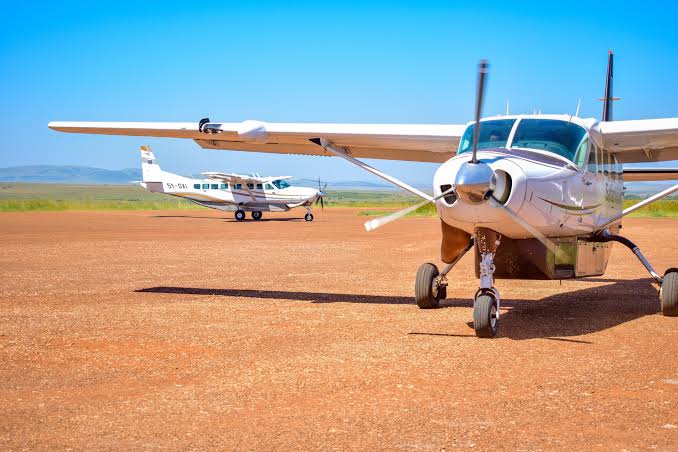
Beyond simply saving time, flying safaris open access to remote areas that would otherwise require multiple days of driving to reach, making a broader multi-park circuit realistic within a limited trip length. Light aircraft transfers also frequently deliver spectacular aerial views over the landscape below, an unexpected, memorable bonus rather than purely a functional transfer between destinations.
Comparing the Two Approaches
| Factor | Overland Drive | Flying Safari |
| Cost | more budget-friendly | Meaningfully more expensive |
| Speed | Hours to a full day per transfer | 45 minutes to 1 hour typically |
| Scenery | immersive ground-level views | Aerial views, less ground detail |
| Access | Limited by road quality and distance | Reaches remote areas efficiently |
| Best suited to | Travelers with time, budget-conscious trips | Time-limited travelers, multi-park circuits |
Practical Middle Ground
Many well-designed itineraries combine both approaches deliberately: an overland drive for the scenic, culturally rich legs of a trip, followed by a flight for the longer, less visually rewarding transfers between more distant destinations. This hybrid approach lets travelers capture the best of both worlds, meaningful ground-level immersion where it adds real value, and efficient time savings where a long drive would otherwise consume a disproportionate share of a limited trip.
Choosing Based on Your Specific Itinerary
For a Uganda-only trip focused primarily on gorilla trekking and one or two additional parks, overland travel works well given the country’s compact circuit of connected destinations. For a Rwanda trip, overland transport is almost always the practical default given the country’s short distances. For travelers combining Uganda or Rwanda with Kenya or Tanzania, or building a longer, multi-country circuit, flying between the more distant legs becomes worth the additional cost, preserving more of your limited trip time for actual wildlife activities rather than transit.
Booking Flights vs. Arranging Ground Transport
Domestic and regional flights within East Africa are typically booked well ahead of travel dates, particularly during peak season, given how quickly popular routes between major hubs fill. Ground transport, whether self-drive or a hired driver-guide, generally offers more last-minute flexibility, though booking your vehicle and driver in advance remains sensible regardless, given how much demand fluctuates across the region’s peak travel windows.
Weather and Seasonal Considerations for Each Option
Light aircraft transfers are generally more weather-dependent than ground transport, with flights occasionally delayed or rerouted during periods of heavy rain or poor visibility. This time around is different if your itinerary includes tight same-day connections. Overland travel faces its own seasonal challenges, unpaved roads becoming considerably more difficult during the wet season, though a well-prepared 4×4 with an experienced driver can generally manage these conditions with only modest additional travel time required.
Comfort and Fatigue Over a Longer Trip
Beyond the individual transfer comparison, cumulative fatigue matters over a longer, multi-leg itinerary. A trip that combines several overland transfers of six-plus hours each can leave travelers so worn down by the midpoint of a two-week itinerary, reducing their energy and enthusiasm for the wildlife activities. Building at least one or two flights into a longer, more ambitious itinerary, even for travelers who otherwise prefer overland travel, often produces a noticeably more enjoyable overall trip.
Booking Windows for Domestic Flights
Domestic flights within Uganda and Rwanda, and the broader regional network connecting to Kenya and Tanzania, should be booked as early as possible, particularly for peak season travel, given how limited daily capacity is on many of these routes compared with major international air corridors. Waiting until you’re already in-country to arrange domestic flights, rather than booking as part of your original itinerary planning, risks encountering sold-out flights on your preferred dates, especially connecting to smaller, less frequently served airstrips near remote parks.
What to Expect on a Light Aircraft Transfer
Light aircraft used for East African safari transfers typically carry between six and twelve passengers, considerably smaller than a standard commercial jet, and baggage allowances are correspondingly stricter, often limited to soft-sided bags under 15 kilograms given weight restrictions on smaller aircraft. Confirming your specific baggage allowance well ahead of travel and packing accordingly from the outset of your trip, rather than discovering the restriction upon arrival, will help you avoid complications at the airstrip.
Frequently Asked Questions
How long does it take to drive from Kampala or Entebbe to Bwindi Impenetrable National Park?
Roughly eight to ten hours, meaning most travelers overnight in Entebbe or Kampala before continuing, adding an extra day to the overall itinerary compared with flying.
Is flying between parks significantly pricier than driving?
Yes, meaningfully so. Fly-in safaris cost considerably more given light aircraft transfers and typically more exclusive accommodation, though they save substantial travel time compared with overland alternatives.
Why is Rwanda considered more convenient for overland travel than Uganda?
Rwanda’s compact geography, roughly the size of Wales, means most major destinations sit within two to four hours of Kigali, a considerably shorter commitment than Uganda’s longer, more remote park distances.
Can I combine driving and flying within a single trip?
Yes, and many well-designed itineraries do exactly that, using overland drives for scenic, culturally rich legs and flights for longer transfers between more distant destinations.
Which option is better for a first-time visitor with limited time?
Flying safaris generally suit time-limited travelers better, since they preserve more available time for actual wildlife activities rather than consuming days in transit between destinations.