Uganda sits at a rare biogeographical crossroads, where East Africa’s savanna species, the Congo Basin’s rainforest specialists, and Albertine Rift endemics all overlap within a single, compact country. The result is one of the richest bird lists on the continent: over 1,060 recorded species, nearly half of Africa’s total, packed into a country roughly the size of the United Kingdom. For birders, that density means genuinely world-class birding is possible without the long overland distances required elsewhere in Africa.
Uganda’s birding reputation has grown steadily among serious international birders precisely because so few countries offer this particular combination of habitats within reach of one another. A single trip here can move from open savanna kingfishers and bee-eaters, to dense lowland rainforest specialists, to high-altitude Albertine Rift endemics found almost nowhere else on the planet, all within a matter of driving hours rather than long domestic flights, making it exceptionally efficient for building a large trip list.
This guide highlights Uganda’s essential birding destinations, its headline species including the prehistoric-looking shoebill stork, the best time of year to visit, and how to structure a birding-focused Uganda itinerary.
Quick Facts
| Total species recorded | Over 1,060, roughly 11% of the world’s bird species |
| Albertine Rift endemics | 24 of Africa’s 37 Albertine Rift endemic species occur in Uganda |
| Signature species | Shoebill stork, great blue turaco, African green broadbill, standard-winged nightjar |
| Top sites | Mabamba Bay, Bwindi national park, Kibale, Semuliki, Queen Elizabeth NP, Murchison Falls NP, Mgahinga |
| Best time to visit | Year-round; November to April adds Palearctic migrants; June to September is driest for forest birding |
| Guiding style | Specialist bird guides available at all major sites and through dedicated birding operators |
| Access from Kampala | Mabamba Bay (shoebills) is under 2 hours from Kampala/Entebbe |
Why Uganda Is One of Africa’s Great Birding Destinations
Uganda’s extraordinary bird diversity comes down to geography. The country straddles the boundary between East Africa’s open savanna, the western edge of the vast Congo rainforest basin, and the Albertine Rift, a chain of mountains and valleys along the western border that is home to an unusually high number of endemic species found nowhere else on Earth. Add wetlands, papyrus swamps, and several major lakes, and the country supports habitats ranging from Afro-alpine moorland above 4,000 meters to lowland tropical forest, each with its own specialist birdlife.
For international birders, this means a two-to-three-week Uganda itinerary can realistically deliver several hundred species, including a strong showing of the notoriously hard-to-see Albertine Rift endemics that draw dedicated birding tour groups from around the world.
The Shoebill Stork: Uganda’s Must-See Bird
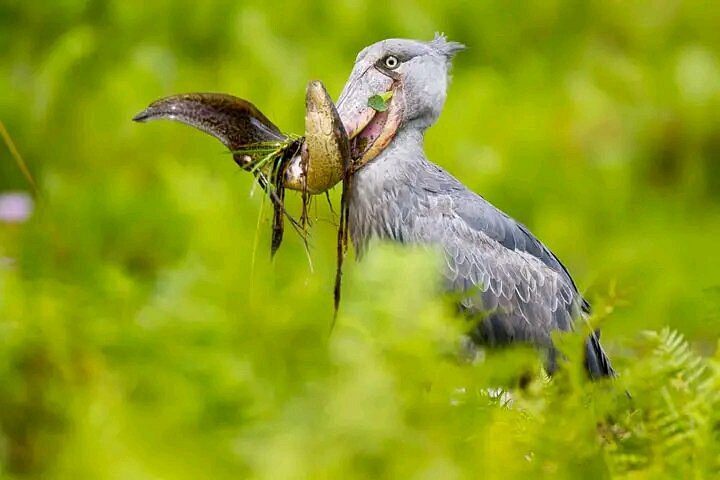
No bird defines Uganda birding quite like the shoebill, a towering, prehistoric-looking stork with a massive, clog-shaped bill, capable of standing motionless for hours before striking with startling speed. Mabamba Bay Wetland on the shores of Lake Victoria, less than two hours from Kampala or Entebbe, is the most reliable and accessible place in Uganda, and arguably in Africa, to see shoebills in the wild, reached by dugout canoe gliding quietly through papyrus channels.
Other reliable shoebill sites include the Nile Delta area of Murchison Falls National Park and parts of Queen Elizabeth National Park’s Kazinga Channel, making it possible to combine shoebill sightings with a broader game-drive safari rather than a dedicated side trip.
Top Birding Destinations Across Uganda
Bwindi Impenetrable National Park
Best known for gorillas, Bwindi is equally prized by birders for its Albertine Rift endemics, including the African green broadbill, Shelley’s crimsonwing and the handsome francolin. Ruhija sector, the highest-altitude part of the park, is particularly productive for forest specialists.
Kibale Forest National Park
Alongside its famous chimpanzees, Kibale hosts the great blue turaco, one of Africa’s most striking birds, plus a strong selection of forest raptors and the elusive African pitta in season.
Semuliki National Park
An extension of the Congo’s Ituri Forest reaching into Uganda, Semuliki offers a genuinely Central African bird list found almost nowhere else in East Africa, including several species otherwise restricted to the Congo Basin.
Queen Elizabeth and Murchison Falls National Parks
Both parks combine savanna and wetland birding with big-game viewing, delivering kingfishers, bee-eaters, raptors and water birds alongside the shoebill in select areas, making them efficient stops for travelers balancing birding with a wider safari.
Mgahinga Gorilla National Park and the Rwenzoris
Uganda’s high-altitude parks add a further layer of specialists to the country’s list. Mgahinga, in the volcanic far southwest, is a stronghold for Rwenzori turaco and several other montane species, while the Rwenzori Mountains themselves host high-altitude endemics found at few other accessible sites in East Africa, rewarding birders willing to combine trekking with their birding.
Best Time of Year for Bird Watching
Uganda offers rewarding birding in every month, but timing can sharpen a trip’s focus. Between November and April, Palearctic migrants arrive from Europe and Asia, boosting species counts around wetlands and lakeshores. The drier months of June to September make forest birding more comfortable, with quieter trails and better visibility in the canopy. Breeding season, roughly September to February for many species, brings out striking plumage and active courtship displays, a bonus for photographers.
Planning a Birding Trip to Uganda
A dedicated birding itinerary in Uganda typically combines a shoebill excursion at Mabamba Bay, several days in Bwindi or Semuliki for Albertine Rift endemics, and a stop at a savanna park like Queen Elizabeth for open-country and wetland species. Specialist bird guides, who can identify species by call alone, make a significant difference to trip lists and are available at all major sites and through dedicated Uganda birding operators.
- Bring a good pair of binoculars (8×42 is a popular all-round choice) and a field guide or app such as Merlin
- A spotting scope is worthwhile for wetland and shoebill sites where birds may be distant
- Early morning is consistently the most productive time of day
- Consider combining birding with gorilla or chimpanzee trekking, since both parks are also outstanding birding sites
How Many Species Can You Realistically See?
Trip lists vary widely depending on itinerary length and focus, but a well-planned two-week Uganda birding trip covering wetlands, forest and savanna commonly yields 400 to 500 species, an exceptional total by any international standard. Dedicated birding tour groups with expert local guides and longer itineraries have recorded well over 600 species on a single Uganda trip, underscoring just how much diversity is packed into a relatively compact country.
Even travelers on a general wildlife safari, without a birding-specific itinerary, typically log 150 to 250 species simply by keeping a checklist alongside their game drives and forest walks, a reflection of how thoroughly birdlife is woven into the Ugandan landscape rather than confined to specialist reserves.
Combining Birding with Uganda’s Other Highlights
Because so many of Uganda’s best birding sites overlap directly with its primate-trekking and game-drive destinations, birding rarely needs to be a separate, standalone trip. Bwindi delivers Albertine Rift endemics alongside gorilla trekking, Kibale offers the great blue turaco alongside chimpanzee trekking, and both Queen Elizabeth and Murchison Falls combine strong bird lists with classic game drives and boat cruises. A general Uganda safari itinerary that simply keeps a checklist running throughout, rather than treating birding as an afterthought, can produce a genuinely impressive species count with minimal extra planning.
Notable Species Beyond the Shoebill
While the shoebill draws the headlines, Uganda’s bird list is deep with other memorable species. The great blue turaco, one of Africa’s largest and most colorful turacos, moves through Kibale’s canopy in noisy, conspicuous troops. The African fish eagle, with its unmistakable ringing call, is a familiar sight along nearly every lake and river in the country. Papyrus specialists like the papyrus gonolek reward patient searching in wetland margins, while the shy, ground-dwelling green-breasted pitta in Kibale is considered one of the most sought-after prizes for visiting bird photographers. Raptor enthusiasts are well served too, with martial eagles, various vultures, and the striking bateleur regularly seen over Uganda’s savanna parks.
Birding Etiquette and Conservation
As with all wildlife tourism in Uganda, responsible birding means keeping a respectful distance from nesting sites, avoiding playback calls to lure sensitive or rare species unnecessarily, and supporting community-run birding guide programs, such as those around Bigodi Wetland near Kibale, that channel tourism income directly into local conservation and livelihoods. Wetland habitats like Mabamba Bay are particularly sensitive to disturbance, so respecting your guide’s positioning of the canoe around shoebill sightings helps protect both the bird and the long-term viability of the site for future visitors.
Frequently Asked Questions
How many bird species are there in Uganda?
Uganda has recorded over 1,060 bird species, roughly 11 percent of all bird species on Earth, packed into a relatively small country thanks to its unique position spanning savanna, rainforest and Albertine Rift habitats.
Where is the best place to see a shoebill stork in Uganda?
Mabamba Bay Wetland, less than two hours from Kampala, is the most reliable and accessible shoebill site in Uganda. Murchison Falls National Park and parts of Queen Elizabeth National Park also offer sightings.
What is the best time of year for bird watching in Uganda?
Uganda offers good birding year-round. November to April brings Palearctic migrants for larger species counts, while June to September offers drier, easier forest birding conditions.
Do I need a specialist guide for birding in Uganda?
It is not required but is highly recommended, particularly for Albertine Rift endemics and forest species that are often identified by call before they are seen. Specialist bird guides are available at all major parks.
Can birding be combined with gorilla trekking?
Yes. Bwindi Impenetrable National Park is both a top gorilla trekking destination and one of Uganda’s best sites for Albertine Rift endemic birds, making it easy to combine both interests in one park visit.
What is an Albertine Rift endemic?
An Albertine Rift endemic is a species found only within the mountains and valleys of the Albertine Rift along Uganda’s western border and neighboring countries. Uganda hosts 24 of the region’s 37 endemic species, more than any other country.
How many bird species could I see on a two-week Uganda trip?
A well-planned two-week birding itinerary covering wetland, forest and savanna habitats commonly produces 400 to 500 species, with dedicated specialist trips sometimes exceeding 600.
Do I need my own binoculars, or can I rent them?
Bringing your own 8×42 binoculars is strongly recommended for comfort and familiarity, though some lodges and operators can provide a pair on request. A spotting scope, if you have access to one, is a valuable addition for wetland and shoebill viewing.
Start Planning Your Uganda Birding Trip
Few countries pack as much avian diversity into as compact and accessible a landscape as Uganda. From the improbable silhouette of a shoebill gliding low over Mabamba Bay’s papyrus to the electric-blue flash of a great blue turaco in Kibale’s canopy, Uganda offers birders a genuinely world-class trip list without the long distances typical of other African birding circuits.
Whether you are a dedicated lister or a curious first-time birder, a Uganda itinerary built around Mabamba Bay, Bwindi and one of the country’s savanna parks will deliver an exceptional and efficient birding trip.