Uganda vs. Rwanda: Which Destination is Best for Your Gorilla Safari? Every serious gorilla trekking conversation eventually arrives at this exact question, and the honest answer is that neither country is objectively better; they’re built around different trade-offs. Uganda offers more gorilla families, considerably lower permit costs, and a more profound wilderness experience. Rwanda offers shorter transfers, gentler terrain, and a more polished, luxury-oriented trip. This guide breaks down every factor that actually matters, rather than defaulting to vague diplomatic hedging.
Fewer than 1,100 mountain gorillas remain in the wild, and they can only be trekked in three countries: Uganda, Rwanda, and the Democratic Republic of Congo. Between the two more commonly visited destinations, the decision comes down to budget, fitness, and what kind of broader trip you’re building around the gorillas themselves.
Permit Cost:
Uganda’s standard gorilla trekking permit costs $800 for foreign non-residents, issued by the Uganda Wildlife Authority. Rwanda’s equivalent, issued by the Rwanda Development Board, costs $1,500, an 87.5 percent premium over Uganda’s price. For a couple, that gap alone represents a $1,400 difference, often enough to fund several additional nights of accommodation or an entirely separate activity elsewhere in the trip.
Rwanda has deliberately positioned its higher price as part of a high-value, low-volume tourism strategy, using the premium to limit visitor numbers while generating stronger conservation revenue per trekker. Uganda, by contrast, has built its reputation around affordability without meaningfully compromising the wildlife experience itself.
A Critical 2026 Policy Change in Uganda
As of March 2026, Uganda eliminated the previous seven-day reservation window that once allowed travelers to tentatively hold a permit before confirming payment. All Uganda permits must now be paid in full at the time of booking, meaning tentative holds are no longer possible. This only changes trip-planning logistics for travelers who previously used that window to finalize other details before committing financially, and it’s worth building into your planning timeline regardless of which country you ultimately choose.
Number of Gorilla Families: Uganda’s Clear Advantage
Uganda hosts more habituated gorilla families than Rwanda, though the exact figures cited vary by source, generally somewhere between 20 and 25 families across Bwindi’s four sectors and Mgahinga’s single Nyakagezi group, compared with Rwanda’s roughly 10 to 12 families in Volcanoes National Park. More families translate directly into more total daily permit slots, better availability during peak season, and a wider variety of trekking sectors and elevations to choose between.
Trek Difficulty: A Trade-off, Not a Clear Winner
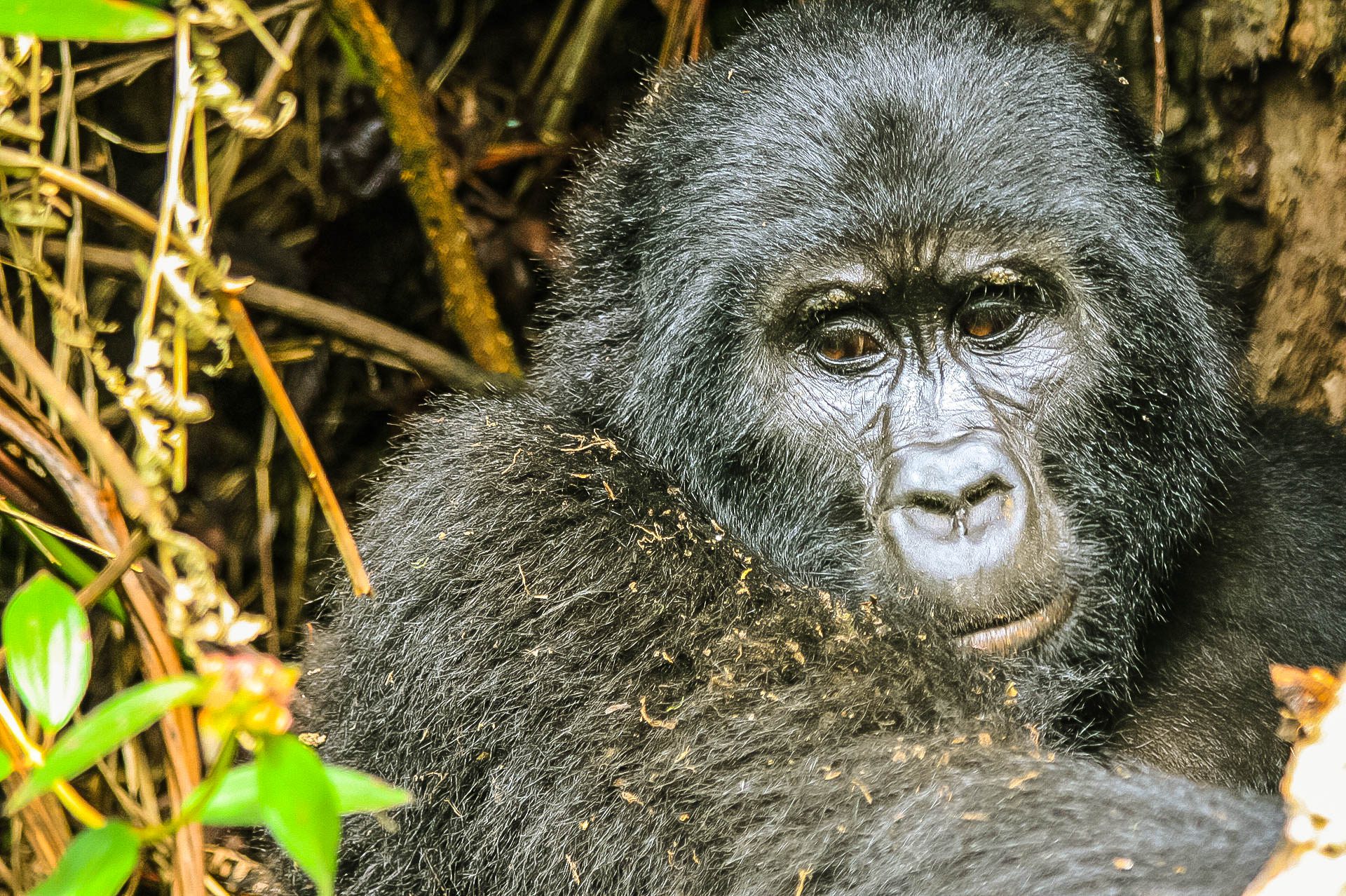
The two countries present different challenges, so it is not accurate to say that one is simply harder than the other. Bwindi’s forest, true to its name, is very dense, layered, and often humid, with treks lasting anywhere from one to eight hours across steep, uneven terrain and thick undergrowth. Rwanda’s Volcanoes National Park sits at a more consistent elevation, with gorilla families generally found at moderate distances from the trailhead, but the altitude itself, combined with steeper individual climbs, presents its own physical challenge.
For travelers with limited fitness specifically, Rwanda’s more predictable terrain and shorter typical trek times generally make it the gentler option, while Uganda rewards travelers willing to embrace a longer, more physically demanding wilderness experience.
Accessibility and Travel Time
Rwanda’s Volcanoes National Park sits roughly two to two-and-a-half hours from Kigali International Airport, making it the more convenient option for travelers with limited time or those wanting to minimize road transfers. Uganda’s Bwindi Impenetrable Forest is considerably further from Entebbe, taking roughly eight to ten hours by road, though flight connections to nearby airstrips can meaningfully cut that transfer time for travelers prioritizing speed over the overland journey’s scenic value.
The Gorilla Habituation Experience
Uganda offers something Rwanda currently does not: a dedicated gorilla habituation experience, costing $1,500, that extends the standard one-hour encounter to up to four hours with a semi-habituated family under direct ranger supervision. For photographers, researchers, or simply travelers wanting considerably more time immersed in gorilla behavior, this represents a point of differentiation currently unique to Uganda.
Photography Conditions
Rwanda generally offers stronger photography conditions given its more open terrain, delivering clearer sightlines and better natural lighting for capturing clean shots. Uganda’s denser forest creates a very atmospheric, moody backdrop, but the thick canopy and undergrowth make achieving clean, well-lit images considerably more technically challenging.
Combining Gorilla Trekking With Other Wildlife
Uganda’s broader safari ecosystem gives travelers flexibility to combine gorilla trekking with chimpanzee tracking at Kibale, savanna game drives at Queen Elizabeth or Murchison Falls, and the tree-climbing lions of Ishasha, all within a single country. Rwanda offers similar combinations, including chimpanzee trekking at Nyungwe and Big Five safaris at Akagera, but these generally require somewhat longer transfers between destinations due to the country’s compact but mountainous geography.
Accommodation Range
Uganda offers a wider accommodation spectrum, from roughly $30 budget campsites through to luxury lodges exceeding $1,500 per night, giving travelers real flexibility across every budget tier. Rwanda’s accommodation skews more heavily toward the premium end, reflecting the country’s broader positioning as a luxury-oriented gorilla trekking destination, though mid-range and budget options do exist for travelers willing to seek them out.
Side-by-Side Comparison
| Factor | Uganda | Rwanda |
| Standard permit cost | $800 | $1,500 |
| Habituated gorilla families | ~20-25 | ~10-12 |
| Distance from capital airport | 8-10 hours by road | 2-2.5 hours by road |
| Habituation experience available | Yes ($1,500) | No |
| Trek terrain | Dense, steep, humid rainforest | More open, consistent elevation, steeper climbs |
| Photography conditions | Atmospheric but challenging | Clearer, better lighting |
| Accommodation range | Budget to ultra-luxury | Mid-range to luxury-focused |
Who Should Choose Uganda
Choose Uganda if the permit cost really matters to your overall budget, if you want the option of a longer, more immersive four-hour habituation experience, if you’re planning to combine gorilla trekking with a broader wildlife safari within the same country, or if you’re simply drawn to a rawer, more physically demanding wilderness encounter.
Who Should Choose Rwanda
Choose Rwanda if minimizing travel time and road transfers is a priority, if you’re building a shorter, more concentrated luxury trip, if photography conditions matter considerably to you, or if you have limited physical fitness and want the gentler, more predictable trekking experience Rwanda’s terrain generally offers.
Can You Do Both?
Yes, and a growing number of travelers with sufficient time do exactly this, combining a Uganda gorilla trek with a subsequent Rwanda visit, or vice versa, via a straightforward cross-border transfer between Kisoro and Musanze. This approach lets you experience both countries’ distinct trekking character within a single trip, though it does require additional time and budget beyond a single-country itinerary.
What About the Third Option: DR Congo?
Virunga National Park in the Democratic Republic of Congo also offers mountain gorilla trekking, at ly the lowest permit price of the three countries, though the wider security and logistics situation in eastern Congo has historically fluctuated, with the park periodically closing to tourism during periods of instability. Most travel consultants recommend Uganda or Rwanda as the considerably more reliable, predictable choice for a first gorilla trekking trip, reserving Congo for travelers with flexibility and a specific interest in that country’s own gorilla population.
Final Verdict
There isn’t a universally correct answer here, only the right answer for your specific priorities. If value, permit availability, and a deeper wilderness experience matter most, Uganda wins decisively. If minimizing travel time, maximizing comfort, and building a shorter, more concentrated luxury trip matter most, Rwanda’s premium justifies itself for many travelers. Both deliver the same extraordinary core experience: one unforgettable hour within meters of a wild mountain gorilla family.
Weather and Climate Differences
Bwindi’s lower average elevation gives it a somewhat warmer, more consistently humid climate than Volcanoes National Park, which sits at a higher altitude and can feel noticeably cooler, particularly in early morning and evening. Neither difference is dramatic enough to shape your destination choice on its own, but travelers particularly sensitive to cold or altitude should factor Rwanda’s cooler, higher setting into their packing and expectations.
Visa and Entry Considerations
Uganda requires an e-visa for most foreign nationals, with no on-arrival option currently available, while Rwanda offers a more streamlined visa-on-arrival process for many nationalities, along with an online application. Travelers combining both countries within one trip, or adding Kenya to the itinerary, should strongly consider the East Africa Tourist Visa, a single $100 multiple-entry visa covering all three countries for 90 days, simply simplifying cross-border logistics regardless of which single country you ultimately prioritize for gorilla trekking itself.
Frequently Asked Questions
Which is cheaper, gorilla trekking in Uganda or Rwanda?
Uganda is significantly cheaper: $800 per permit versus Rwanda’s $1,500, an 87.5 percent premium that adds up considerably for couples or families.
Which country has more gorilla families to trek?
Uganda, with roughly 20 to 25 habituated families across Bwindi and Mgahinga, compared with Rwanda’s approximately 10 to 12 families in Volcanoes National Park.
Which is more physically demanding, Uganda or Rwanda?
Both are demanding in different ways. Uganda’s terrain is muddier and denser through thick rainforest; Rwanda’s challenge comes more from altitude and steeper individual climbs.
Can I do the four-hour Gorilla Habituation Experience in Rwanda?
No, this extended experience is currently unique to Uganda, priced at $1,500 for up to four hours with a semi-habituated family.
Is it possible to combine both Uganda and Rwanda gorilla trekking in one trip?
Yes, via a straightforward cross-border transfer between Kisoro (Uganda) and Musanze (Rwanda), letting travelers with sufficient time and budget experience both countries’ distinct trekking styles.