Ultimate Primate Haven & Chimpanzee Tracking
Kibale National Park has a unique claim in East Africa: 13 primate species share 795 square kilometers of moist evergreen rainforest, making it the area with the highest primate density on the continent, with about 1,500 chimpanzees in several habituated communities.
This guide walks through exactly what a Kibale visit costs, how the two chimp-trekking options differ, and which of the park’s other primates and activities are worth building into your stay.
Located 36 kilometers south of Fort Portal in western Uganda‘s Kabarole and Kamwenge districts, Kibale sits roughly five to six hours by road from Kampala or Entebbe and functions as a natural link between Queen Elizabeth National Park and Uganda’s western gorilla-trekking circuit.
Standard Trekking vs. the Habituation Experience
Kibale offers two distinct, legally separate ways to track chimpanzees. The standard chimpanzee trekking permit, currently $250 for foreign non-residents, $200 for foreign residents, and UGX 180,000 to 200,000 for East African citizens, grants a strict one-hour observation window with a habituated community, departing from Kanyanchu in either a morning or afternoon session.
The Chimpanzee Habituation Experience, priced at $300 for foreign non-residents, extends that window to a full four hours, joining researchers and rangers actively working to habituate a community still becoming accustomed to human presence.
The practical difference is more than just extra time: the habituation experience provides real behavioral depth and research access, allowing you to see the actual process of habituation unfold instead of just watching a fully settled group. Several operators also recommend scheduling it before a gorilla trek elsewhere in Uganda, since the longer, more demanding day helps prepare travelers physically and mentally for the more strenuous gorilla trekking experience that often follows later in a combined itinerary.
How Many Permits Exist, and When to Book
Only about 32 standard trekking permits are issued daily at Kanyanchu, a hard limit that sells out months in advance during peak season, June through August specifically. Habituation experience permits are considerably scarcer still, with roughly 12 available in the park at any given time. Booking three to six months ahead is the standard, sensible recommendation through the Uganda Wildlife Authority or a licensed operator, and last-minute walk-in availability should never be assumed regardless of season.
What a Chimp Trek Actually Involves
Trekking is a genuine, active wilderness pursuit rather than a passive wildlife drive: small groups of six to eight visitors hike ranger-led trails through dense forest, listening for pant-hoots and drumming to help locate the target community. Once found, visitors observe from a regulated distance of roughly seven to ten meters for the permit’s allotted time, watching feeding, grooming, and social interaction unfold with minimal disturbance.
Kibale’s success rate, due to decades of habituation work and the high density of its chimpanzee population, is regularly over 95 percent, which is higher than in comparable destinations like Tanzania’s Mahale Mountains or Rwanda’s Nyungwe Forest, where weather and much more difficult terrain reduce visibility more often.
Other Twelve Primate Species
Chimpanzees understandably dominate Kibale’s reputation, but the park’s genuine claim to being the primate capital of the world rests on its full roster: red colobus, black-and-white colobus, grey-cheeked mangabey, L’Hoest’s monkey, red-tailed monkey, and vervet monkey are all reliably encountered on standard forest walks, often without any additional permit beyond the base park entrance fee. This depth means even travelers who don’t secure a chimp permit for their preferred date still experience rich primate viewing across the rest of their stay.
Night Walks
Kibale’s guided night walks reveal an entirely different, rarely seen side of the forest: nocturnal primates, including potto and galago (bush baby), whose reflective eyes shine distinctively in a flashlight beam, alongside chameleons, tree hyrax, genet cats, and owls.
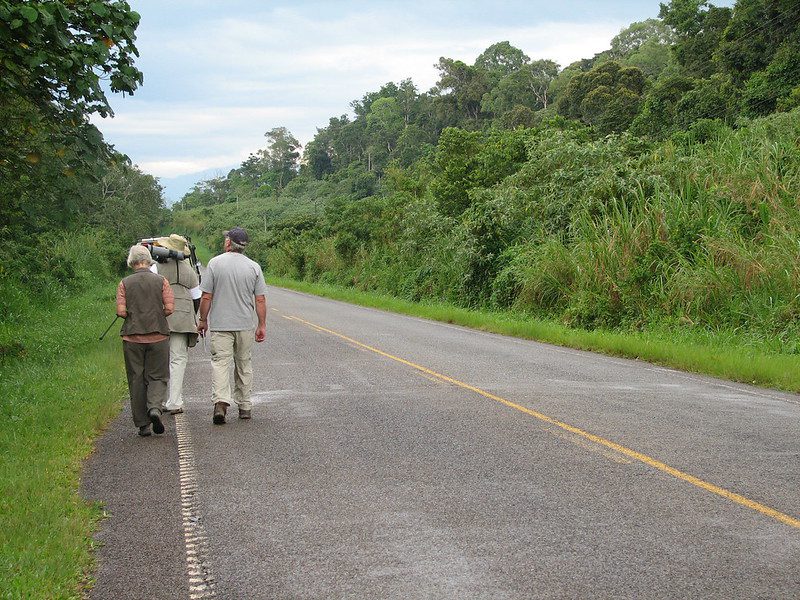
This activity is underrated relative to daytime trekking and worth adding for travelers with an extra evening free, since it delivers a completely different wildlife experience from anything available during standard daylight hours.
Bigodi Wetland Sanctuary
Adjacent to the main park, the community-managed Bigodi Wetland Sanctuary offers exceptional birdwatching along a 4.5-kilometer boardwalk trail, with more than 200 recorded species, including the Great Blue Turaco and multiple kingfisher species, alongside primates, including the red colobus and black-and-white colobus, visible from the trail itself.
Local villages manage the sanctuary directly and receive tourism revenue that funds schools, healthcare, and development projects, meaning the roughly $10 entry fee translates into genuine, tangible community benefit. Guided walks last two to three hours and pair naturally with a chimp trek on either the same or the following day.
Birding Beyond Bigodi
Within the main park itself, Kibale’s bird list runs past 350 species, including several genuine specialties: the black bee-eater, yellow-rumped tinkerbird, yellow-spotted nicator, little greenbul, black-capped apalis, collared apalis, and purple-breasted sunbird.
Dedicated birding excursions can be arranged separately from standard chimp trekking, worth considering for travelers with a genuine interest in the park’s forest-specialist species beyond what a general nature walk typically covers.
Cultural Engagement in Bigodi Village
Beyond the wetland walk itself, the Bigodi community offers genuine hands-on cultural activities: coffee roasting, banana beer brewing, and local cuisine preparation, all led directly by community members rather than staged for passing visitors. This pairing of conservation-funded wetland tourism with authentic cultural engagement gives Bigodi a distinctive character among Uganda’s community-tourism offerings.
Sample Itineraries by Length
| Length | Focus |
| 1 day | Morning chimp trek, optional afternoon Bigodi Wetland walk |
| 2 days | Standard chimp trek plus a dedicated night walk and birding excursion |
| 3 days | Standard trek, full-day habituation Experience, nature walk, and Bigodi community visit |
Where to Stay
Kibale’s lodge options span a genuine range: Kyaninga Lodge and Ndali Lodge offer the strongest luxury tier, both set on scenic crater lakes near the park, while Primate Safari Lodge, Chimps’ Nest, Kibale Forest Cottages, Kibale Safari Lodge, and Kibale Forest Camp cover the mid-range and budget tiers. Several properties sit close enough to Kanyanchu for a short transfer on a trekking morning, worth confirming directly given how much a longer drive can compress an already tight morning schedule.
Getting There and Combining With Other Parks
Kibale sits roughly five to six hours by road from Kampala or Entebbe, or approximately 45 minutes by domestic flight for travelers prioritizing time. Its position makes it a natural link in Uganda’s classic western circuit: many itineraries combine Kibale’s chimpanzees with Queen Elizabeth National Park’s savanna and Kazinga Channel, then continue to Bwindi Impenetrable National Park for gorilla trekking, delivering Uganda’s full primate range, including chimpanzees, savanna wildlife, and mountain gorillas, all within a single well-sequenced week.
Best Time to Visit
Chimp trekking happens year-round given the habituated communities’ consistent presence, though the dry seasons, December through February and June through September, offer firmer forest trails. Morning humidity affects chimp movement patterns, and guides note this when planning which session, morning or afternoon, offers the better odds on a given day, worth discussing directly with your operator rather than defaulting to whichever slot happens to be available.
What to Pack for Chimp Trekking
Kibale’s forest floor stays damp regardless of season, and sturdy, waterproof hiking boots matter as much here as at Bwindi, alongside long trousers and sleeves for protection against undergrowth and biting insects. A rain jacket is essential regardless of month, given the forest’s own microclimate, and gardening gloves help on the steeper, more overgrown sections of the trail. Insect repellent, sufficient water, and cash for tipping guides and porters round out the essential list.
Combining Kibale with the Rest of Uganda
Kibale’s location in western Uganda makes it a natural link in the country’s classic circuit: pairing chimpanzee trekking here with Queen Elizabeth National Park’s savanna wildlife and Kazinga Channel, and then continuing to Bwindi Impenetrable National Park for gorilla trekking, gives travelers Uganda’s full primate and savanna range in a single well-sequenced week to ten days. For travelers with additional time, extending north to Murchison Falls rounds out the circuit with the country’s largest and most complete single park.
Frequently Asked Questions
How much does chimpanzee trekking cost at Kibale National Park?
$250 for foreign non-residents for the standard one-hour trek and $300 for the four-hour Chimpanzee Habituation Experience, both under the current 2024-2026 UWA tariff.
How many chimp trekking permits are available each day?
Only about 32 standard permits are issued daily at Kanyanchu, with roughly 12 available for the Habituation Experience, both hard limits that sell out months ahead during peak season.
What’s the difference between standard trekking and the Habituation Experience?
Standard trekking grants a strict one-hour observation window with an already fully habituated community; the Habituation Experience extends this to four hours, joining researchers actively working to habituate a community still adjusting to human presence.
What other primates can I see at Kibale besides chimpanzees?
Twelve further species, including the red colobus, the black-and-white colobus, the grey-cheeked mangabey, L’Hoest’s monkey, and the red-tailed monkey, are the highest primate diversity anywhere in East Africa.
How reliable are chimp sightings at Kibale?
The reliability of chimp sightings at Kibale is high, with a success rate regularly exceeding 95 percent, thanks to decades of established habituation work and the park’s sheer chimpanzee density, which is higher than that of comparable destinations in Tanzania or Rwanda.