Uganda is home to just over half of the world’s remaining mountain gorillas, and gorilla trekking here is widely regarded as one of the most extraordinary wildlife encounters on the planet. Deep inside the tangled, mist-covered slopes of Bwindi Impenetrable National Park and the volcanic foothills of Mgahinga Gorilla National Park, small groups of travelers hike through dense montane forest to spend a profound hour with a habituated gorilla family in the wild.
This guide covers everything a first-time visitor needs to plan a gorilla trekking experience in Uganda: where to go, how much permits cost in 2026, when to travel, what a trekking day actually looks like, how fit you need to be, and how gorilla tourism directly funds the conservation of an endangered species. Whether you are booking a single add-on activity or building an entire Uganda safari around it, gorilla trekking rewards careful planning.
Quick Facts
| Where | Bwindi Impenetrable National Park (4 sectors) and Mgahinga Gorilla National Park, southwestern Uganda |
| Permit cost (2026) | USD 800 foreign non-resident / USD 700 foreign resident / USD 500 African non-EAC / ~USD 80 (UGX 300,000) East African citizens |
| Habituation experience | USD 1,500 per person (4 hours with a semi-habituated family, Rushaga sector only) |
| Time with gorillas | One hour, once located (standard permit) |
| Trek duration | 2 to 8 hours round trip, depending on where the family is that day |
| Minimum age | 15 years |
| Best time to go | June to August and December to February (driest trails); April, May and November offer discounted permits |
| Fitness level | Moderate to challenging; steep, muddy terrain at altitude |
Where to Go Gorilla Trekking in Uganda
Almost all gorilla trekking in Uganda takes place in Bwindi Impenetrable National Park, a UNESCO World Heritage Site in the country’s far southwest. Bwindi is divided into four trekking sectors, each with its own habituated gorilla families and its character.
Buhoma, in the north, is the longest-established sector with excellent lodge infrastructure and generally gentler terrain. Ruhija sits at the highest altitude and is a favorite among birders. Rushaga, in the south, has the highest number of habituated families and is the only sector offering the gorilla habituation experience. Nkuringo, perched on a ridge above the forest, is known for dramatic scenery and a tougher final climb back out.
A smaller number of gorilla treks depart from Mgahinga Gorilla National Park, further south along the border with Rwanda and the Democratic Republic of Congo. Mgahinga’s Nyakagezi gorilla family roams across three dormant volcanoes, so availability here can be less predictable, but the park doubles as a gateway to golden monkey tracking and volcano hikes, making it a worthwhile detour for travelers who want to combine several activities in one region.
How Much Does a Gorilla Permit Cost in 2026?
The Uganda Wildlife Authority (UWA) is the sole body authorized to issue gorilla permits, and pricing is tiered by residency status. As of 2026, a standard one-hour trekking permit costs USD 800 for foreign non-residents, USD 700 for foreign residents holding a valid Ugandan work permit, USD 500 for African citizens from outside the East African Community, and roughly USD 80 (UGX 300,000) for East African Community citizens.
UWA has also periodically offered discounted low-season permits of around USD 600 during the quieter months of April, May and November, so it is always worth asking your operator whether a seasonal promotion is currently running.
For travelers who want a longer, more immersive encounter, the gorilla habituation experience allows up to four hours with a family that rangers and researchers are still in the process of habituating.
This costs USD 1,500 per person, is limited to two small groups of four people per day, and is only offered in Bwindi’s Rushaga sector. Permit prices are reviewed periodically, so always confirm current rates directly with UWA or a licensed Uganda tour operator before booking. As of March 2026, full payment is required at the time of booking rather than a holding deposit.
- Permit price includes park entry, ranger-guide services, trackers, and security
- Only eight visitors are permitted per gorilla family, per day, for one hour
- About 160 to 176 standard permits are available across Uganda each day
- Permits should be booked 3 to 6 months ahead for June to September and December to February travel
Best Time of Year for Gorilla Trekking
Bwindi’s name is well earned; this is genuinely an impenetrable, high-rainfall forest, and it can rain at any point in the year. That said, the two drier windows, from June to August and from December to February, offer firmer trails, lower humidity and easier underfoot conditions, which is why they are also the busiest and most expensive months to book. The wetter ‘green seasons’ of March to May and September to November bring more frequent showers but also lush scenery, thinner crowds, and, in some years, discounted permit pricing.
Because gorillas move daily and rangers track their overnight nesting sites each morning, there is no season in which a sighting is guaranteed to be effortless, but Uganda’s overall gorilla sighting success rate remains extremely high, generally quoted at well above 95 percent, because rangers monitor family movements continuously.
What to Expect on Trekking Day
Trekking days start early. Visitors gather at their sector’s briefing point, typically between 7:00 and 7:30 a.m., where park rangers assign groups of a maximum of eight people to a specific gorilla family and explain forest etiquette. From there, a ranger-guide and armed tracker lead the group into the forest, following signs left by trackers who set out at dawn to relocate the family’s overnight nesting spot.
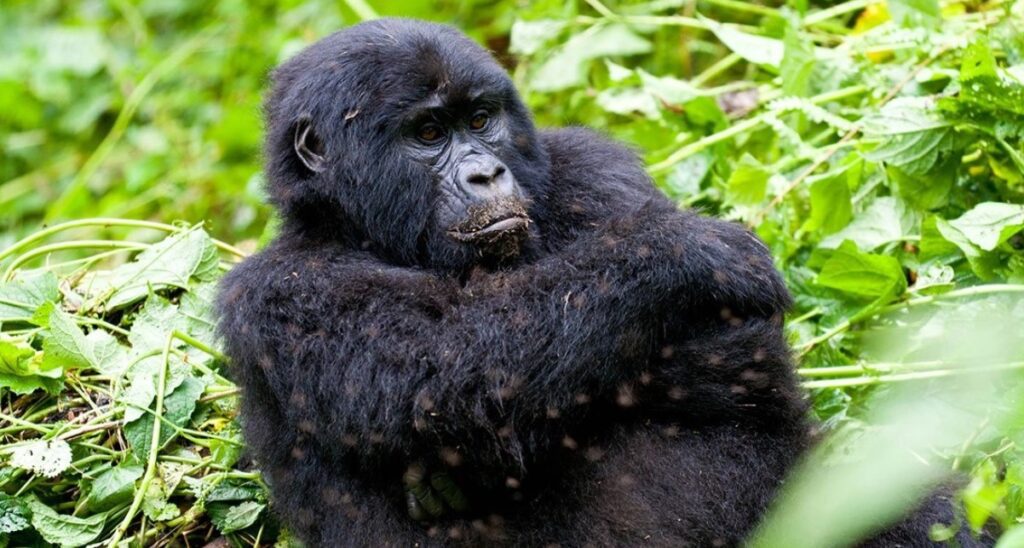
The hike itself is unpredictable. Some families are found within an hour of gentle walking; others require a genuinely strenuous four-to-eight-hour push through steep, overgrown terrain. Once the family is located, visitors leave backpacks and walking sticks with porters and approach quietly for a single, unforgettable hour of observation, watching gorillas feed, rest, and interact at a mandated minimum distance, currently set at 10 meters under 2026 protocols designed to prevent disease transmission between humans and gorillas, who share roughly 98 percent of our DNA.
- A surgical-style face mask is required in the presence of the gorillas
- Flash photography is prohibited and voices should stay low
- Do not trek if you have a cough, cold, or fever; report symptoms to the warden before setting off
- Porters can be hired at the trailhead for a modest fee and are warmly encouraged, both for support on the trail and as a direct source of community income
Fitness, Difficulty and What to Pack
Gorilla trekking is rated moderate to challenging. Trails climb and descend steep, often muddy volcanic slopes at altitudes between roughly 1,400 and 2,600 meters, and there is no way to know in advance whether a trek will take one hour or eight.
Reasonable fitness helps enormously, but plenty of trekkers in their sixties and seventies complete the hike each year, often with the help of a hired porter and a good walking pace rather than raw athleticism. For travelers concerned about their mobility, some sectors can arrange a sedan chair carried by a team of porters for an additional fee.
Pack as if you were hiking in a rainforest, because you are. Sturdy, ankle-supporting waterproof boots are essential, along with gardening-style gloves for gripping vegetation, long trousers tucked into socks to deter safari ants, a rain jacket, a hat, and a daypack with water and energy snacks. Many operators recommend gaiters. A modest tip for your ranger-guide and porters at the end of the day is customary and appreciated.
Combining Gorilla Trekking with Other Uganda Experiences
Because Bwindi and Mgahinga sit in Uganda’s far southwest, most itineraries link gorilla trekking with nearby highlights rather than treating it as a stand-alone trip. Lake Bunyonyi, a short drive from Bwindi’s southern sectors, offers a peaceful, malaria-free stop for canoeing and relaxing after the trek. Many travelers continue north to Queen Elizabeth National Park for game drives and chimpanzee tracking in Kyambura Gorge or combine their trip with dedicated chimpanzee trekking in Kibale Forest National Park, giving them a genuine ‘great ape safari’ covering both species in a single loop.
Gorilla Tourism and Conservation
Mountain gorillas were once feared to be heading toward extinction, but decades of carefully managed, high-value, low-impact tourism have helped their numbers grow steadily, and the species’ conservation status has improved as a direct result. Permit revenue funds ranger salaries, anti-poaching patrols, and community development programs in the villages bordering the park, including the 20 percent of permit fees that UWA channels directly back into local communities. Choosing to trek gorillas in Uganda is, in a very real sense, a way of directly financing the survival of the species.
Frequently Asked Questions
How much does a gorilla permit cost in Uganda in 2026?
A standard one-hour gorilla trekking permit costs USD 800 for foreign non-residents, USD 700 for foreign residents, USD 500 for African citizens outside the East African Community, and around USD 80 for East African Community citizens. The four-hour habituation experience costs USD 1,500. Always confirm current pricing with UWA or a licensed operator, as tariffs are reviewed periodically.
What is the minimum age for gorilla trekking in Uganda?
Visitors must be at least 15 years old to trek mountain gorillas in Uganda. There is no upper age limit, provided you are reasonably fit and can be assisted by a porter if needed.
How difficult is gorilla trekking?
It ranges from moderate to strenuous. Trails are steep, often muddy, and located at altitude, and trek length can vary from one to eight hours depending on where the gorilla family happens to be that day. Hiring a porter is highly recommended for all fitness levels.
Is gorilla trekking in Uganda cheaper than in Rwanda?
Yes. Uganda’s standard permit costs USD 800, compared with USD 1,500 in Rwanda, making Uganda the more affordable option for the same essential experience of one hour with a habituated mountain gorilla family.
What should I pack for gorilla trekking?
Waterproof hiking boots, gardening gloves, long trousers, a rain jacket, a hat, insect repellent, water, energy snacks, and a small daypack. A face mask is mandatory during the gorilla encounter.
What happens if the gorillas are not found?
This is extremely rare given continuous ranger tracking, but UWA policy generally allows for a partial refund or a rescheduled trek if a family genuinely cannot be located, so ask your operator to confirm the current policy at booking.
Can I photograph the gorillas?
Yes, standard photography is welcome and encouraged, but flash photography is strictly prohibited because it can startle or distress the gorillas.
How far in advance should I book a gorilla permit?
For travel during peak months, June to September and December to February, book 3 to 6 months in advance. Since March 2026, UWA requires full payment at the time of booking, so permits are secured on a first-paid, first-served basis.
Planning Your Gorilla Trek
Gorilla trekking in Uganda is not a casual afternoon activity; it takes planning, a reasonable level of fitness, and a permit secured well ahead of your travel dates. But for the vast majority of travelers who make the effort, an hour spent quietly watching a silverback and his family move through the forest becomes the single most memorable experience of their trip, and often of their travels anywhere.
Ready to trek? Book your gorilla permit through a licensed Uganda tour operator, choose your sector based on fitness level and season, and start counting down to one of Africa’s greatest wildlife encounters.