Gishwati-Mukura National Park is different from every other national park covered in this guide, not because of a single headline species, but because of what it represents: a forest deliberately rebuilt from the consequences of decades of deforestation, agriculture, and settlement, rather than a landscape that survived largely intact. This guide covers that restoration story, what wildlife you can expect, and why this quiet, still relatively undiscovered park deserves serious consideration.
Established in 2015 as Rwanda’s fourth and newest national park, Gishwati-Mukura sits in the country’s western Rutsiro and Ngororero districts, positioned between Volcanoes National Park to the north and Nyungwe Forest National Park to the south, and holds a genuine practical distinction: it’s currently the national park closest to Kigali.
Two Forest Fragments, Joined Together
Gishwati-Mukura combines two previously separate forest fragments, Gishwati Forest and Mukura Forest, into a single protected area covering roughly 340 square kilometers. Much of the original montane forest that once covered large stretches of western Rwanda was lost during the twentieth century to logging, agricultural expansion, and human settlement, and Gishwati-Mukura’s creation represents a genuine, deliberate effort to reverse that loss and reconnect what remained into a functioning conservation corridor.
In 2019, the Rwanda Development Board signed a 25-year concession agreement specifically to drive this restoration forward, and conservation organizations working alongside RDB continue active reforestation, wildlife monitoring, and sustainable tourism development across the park today. A genuine, ongoing challenge remains species isolation, since joining two previously fragmented forest patches doesn’t instantly restore full ecological connectivity, but the park’s creation itself marks real, tangible conservation progress that Rwanda points to with genuine pride.
Chimpanzees
Gishwati-Mukura and Nyungwe National Parks are the only two remaining habitats for Eastern chimpanzees anywhere in Rwanda, a significant distinction given how limited chimp range has become within the country’s borders. The park’s chimpanzee community numbers around 20 individuals in a currently trackable group, considerably smaller than Nyungwe’s several hundred, reflecting the park’s genuine status as a still-recovering, comparatively young conservation project rather than an established, mature ecosystem.
Golden Monkeys and Further Primates
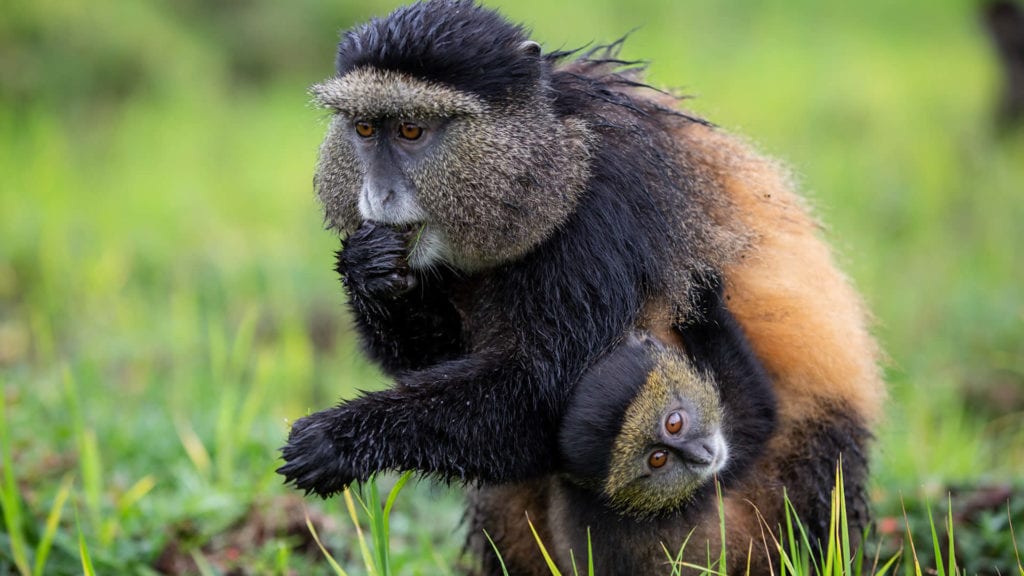
Beyond chimpanzees, Gishwati-Mukura hosts golden monkeys (Cercopithecus mitis kandti), L’Hoest’s monkey, blue monkeys, and black-and-white colobus monkeys, giving the park a rich primate roster for its modest overall size. Golden monkey trekking here offers a genuine alternative to Volcanoes National Park’s more established, considerably busier equivalent, delivering the same species within a considerably quieter, less-visited setting.
Birds
Bird counts differ significantly between the park’s two forests: Gishwati Forest has about 230 to 232 recorded species, while Mukura Forest has around 126 to 163, depending on the source, together contributing to a total of over 200 species in the park. Genuine Albertine Rift endemics are common here, including the Rwenzori turaco and Grauer’s swamp-warbler, making Gishwati-Mukura a great place for dedicated birders to add to their comprehensive Rwanda species list.
Beyond Birds and Primates
The park’s biodiversity extends well beyond its headline wildlife: amphibians, including brown forest frogs and multiple toad species; reptiles, including the Great Lakes bush viper and several chameleon species; and the Satinsyi River, home to a highly endangered fish species (Haplochromis erythromaculatus) found nowhere else. Around 60 tree species, including indigenous hardwoods and bamboo, round out a rich, still-recovering ecosystem across the park’s roughly 340 square kilometers.
Uncrowded Experience
Gishwati-Mukura remains Rwanda’s least-visited national park, and this obscurity is part of its appeal for travelers who’ve already experienced the more crowded gorilla-trekking circuit at Volcanoes National Park. Guided forest walks here move through rolling hills, scenic ridges, and restored natural habitat with a genuine sense of quiet solitude, and the park’s setting, surrounded by tea plantations and traditional pastoral land, adds a distinctive cultural backdrop to the wildlife experience.
Activities
Beyond chimpanzee and golden monkey trekking, Gishwati-Mukura offers guided nature hikes, dedicated birdwatching excursions, and, at select operators, visits to local communities for genuine cultural immersion alongside the park’s community-led conservation projects, giving travelers a chance to engage directly with the human side of the restoration story alongside the wildlife itself.
Getting There
Given its position as the national park closest to Kigali, Gishwati-Mukura is more accessible than Rwanda’s other major parks, though it still requires careful route planning given the country’s mountainous terrain. A private transfer with a driver-guide from Kigali, or a route that combines Gishwati-Mukura with a wider western Rwanda circuit toward Musanze or Nyungwe, works well depending on your overall itinerary.
Why This Belongs on a Second or Third Rwanda Trip
For travelers who’ve already experienced gorilla trekking in Volcanoes National Park and visited Nyungwe’s chimpanzees and canopy walkway, Gishwati-Mukura offers a different, considerably quieter primate-focused experience and a chance to directly witness what forest restoration actually looks like on the ground, rather than simply hearing about conservation success in the abstract. Every visit here contributes directly to a still-developing conservation project, giving the trip a tangible sense of contribution beyond the wildlife encounter itself.
Best Time to Visit
The dry seasons, June through September and December through February, offer the firmest trail conditions across Gishwati-Mukura’s forest terrain, consistent with the timing recommendations for Rwanda’s other primate-trekking parks.
What a Visit Costs
Given its status as Rwanda’s newest and least commercially developed park, Gishwati-Mukura’s activity pricing generally runs lower than the country’s more established destinations. Chimpanzee trekking and golden monkey tracking permits, along with guided nature walks and birding excursions, are typically arranged directly through the Rwanda Development Board or a local tour operator, and confirming current pricing directly is worthwhile given how recently the park’s tourism infrastructure has developed.
Getting There and Where to Stay
Given the park’s position closest to Kigali among Rwanda’s national parks, day-trip access is feasible for travelers based in the capital, though an overnight stay allows a more relaxed, unhurried exploration of the forest’s trails. Accommodation directly around Gishwati-Mukura remains limited compared with Rwanda’s more established parks, and many visitors base themselves in nearby towns or combine the park with a wider western Rwanda circuit toward Musanze or Nyungwe.
Why Forest Restoration Projects Matter
Gishwati-Mukura’s creation reflects a broader, important shift in African conservation thinking: rather than only protecting land that remains pristine, deliberately investing in restoring degraded landscapes back to functioning ecosystems. This approach carries real significance beyond Rwanda’s borders, offering a genuine model other countries facing similar deforestation histories can study and potentially replicate, and a visit here supports precisely this kind of forward-looking conservation work.
Frequently Asked Questions
When was Gishwati-Mukura National Park established?
2015, making it Rwanda’s fourth and newest national park, created by joining two previously separate forest fragments, Gishwati and Mukura, into a single protected area.
How does Gishwati-Mukura compare to Nyungwe for chimpanzee trekking?
Gishwati-Mukura’s chimpanzee community is considerably smaller, around 20 individuals, compared with Nyungwe’s several hundred, but it offers a quieter, less-crowded trekking experience.
Is Gishwati-Mukura the closest national park to Kigali?
Yes, currently the closest of Rwanda’s national parks to the capital, though it still requires careful route planning given the country’s mountainous terrain.
What makes Gishwati-Mukura different from Rwanda’s other parks?
It is a planned forest restoration project, not a mostly intact ecosystem, rebuilt after decades of deforestation and agricultural encroachment under a 25-year Rwanda Development Board concession agreement signed in 2019.
Can I see golden monkeys at Gishwati-Mukura instead of Volcanoes National Park?
Yes, the park hosts its own golden monkey population, offering a genuine alternative to Volcanoes National Park’s busier, more established trekking experience.