Luxury vs. Mid-Range vs. Budget Safaris: What to Expect; Uganda and Rwanda safari costs span an enormous range, from roughly $250 per person per day at the budget end to $2,500 or more at the ultra-luxury tier. Understanding exactly what changes between these tiers and what stays remarkably consistent regardless of budget helps you spend your money where it improves the experience rather than paying for amenities that don’t actually matter to you.
One consistent truth across every tier: the wildlife experience itself, the gorillas, the game drives, and the core encounters remain identical regardless of how much you spend on accommodation and comfort around it. What changes is everything surrounding that core experience.
Uganda Pricing by Tier
Uganda safari costs in 2026 range from roughly $150 to $1,200 per person per day depending on your chosen tier. Budget travelers should allocate $250 to $350 daily, mid-range explorers $450 to $700, and luxury seekers $1,000 to $2,500. Across a full trip, budget packages run $1,500 to $3,500, mid-range $3,000 to $7,000, and luxury $8,000 to $20,000 or more, figures that include the mandatory $800 gorilla permit, accommodation, meals, guiding, and 4×4 transport between destinations.
Uganda lodge pricing specifically spans $100 to $180 per night at the budget tier, $150 to $300 for mid-range, and $400 to $800 or more for luxury properties, with luxury lodges delivering world-class service, fine dining, and prime locations directly bordering the country’s top wildlife destinations.
Rwanda Pricing by Tier
Rwanda’s overall safari costs run higher than Uganda’s, reflecting both the $1,500 gorilla permit and the country’s broader positioning as a premium destination. A three-day budget Rwanda safari starts around $2,450 per person, while mid-range packages average $3,800 to $5,200. Luxury expeditions featuring ultra-luxe lodges like Singita Kwitonda or One&Only Gorilla’s Nest typically exceed $7,500 for a comparable duration.
Rwanda lodge pricing specifically: budget properties run $300 to $600 per night, mid-luxury options like Magashi Camp in Akagera run $1,500 to $2,000, and ultra-luxury properties like Bisate Lodge exceed $3,000 nightly, with Singita Kwitonda and comparable properties reaching $2,500 to $3,500. These premium prices reflect exclusivity, location, and amenities rather than superior wildlife access; the gorillas themselves are identical regardless of which tier you book.
What Changes Between Tiers
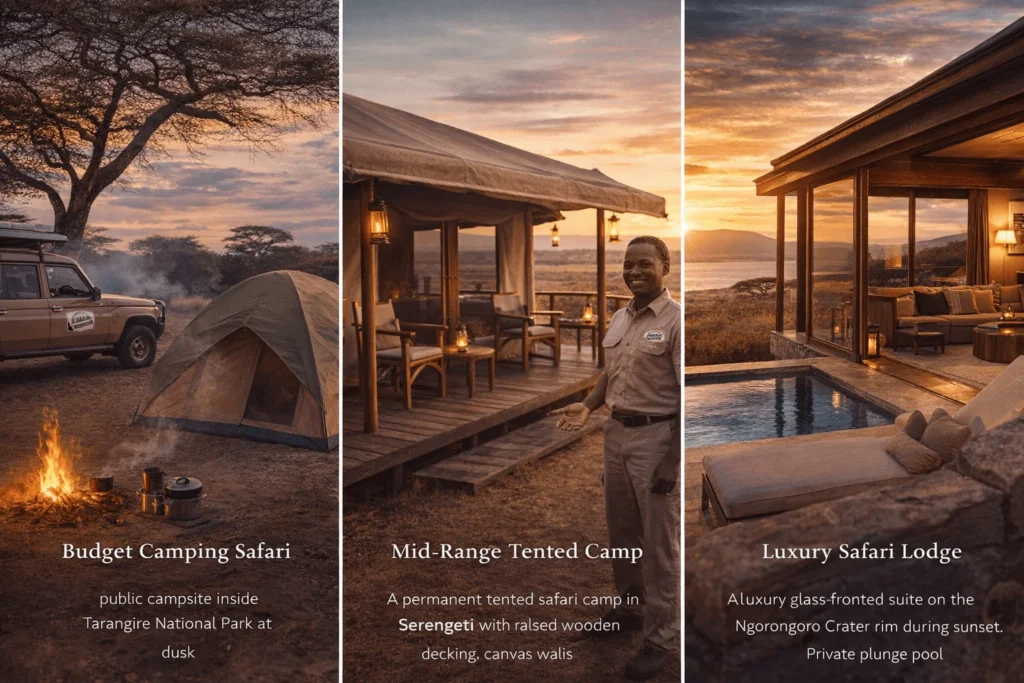
Budget lodges focus on clean, basic comfort: simple rooms, straightforward meals, and friendly service, often in scenic locations near the parks despite their modest amenities. Mid-range properties strike what most travelers consider the strongest overall value: comfortable rooms, quality meals, and better locations without paying for luxury extras you may not need. Luxury lodges deliver five-star amenities, fine dining, spa facilities, and often exceptional architecture and design, alongside prime positioning directly on the edge of key wildlife areas.
Vehicle and Transport Differences
Budget safaris typically use shared 4×4 safari vans on scheduled group departures, splitting vehicle and fuel costs, often $150 to $250 daily, across multiple travelers. Mid-range and luxury trips generally include a private vehicle and dedicated driver-guide throughout, offering considerably more flexibility in pacing and route but at a correspondingly higher per-person cost given you’re no longer sharing that expense with other travelers.
Fixed Costs That Don’t Change by Tier
Regardless of which accommodation tier you choose, several costs remain fixed: gorilla trekking permits ($800 Uganda, $1,500 Rwanda), the East Africa Tourist Visa ($100, or $50 for Rwanda’s single-entry equivalent), and porter fees, typically $10 to $20 per trek, essential support for local communities living adjacent to the parks. These fixed costs represent a larger proportion of a budget trip’s total cost than a luxury trip’s, worth factoring into your overall comparison rather than assuming budget travel scales linearly cheaper across every line item.
Useful Cost-Saving Strategies
Book circuit safaris that start in one city and end in another, Entebbe to Kigali, for instance, rather than looping back to your starting point, saving considerable backtracking drive time, fuel costs, and driver-guide fees.
Choose lodges offering full board that excludes drinks, then purchase your own refreshments locally, a detail that can save $200 or more across a ten-day trip given how quickly lodge bar tabs accumulate. Traveling during shoulder seasons, March through May and November, can save 20 to 30 percent on accommodation across every tier, while gorilla permits themselves remain fixed price regardless of season in most cases.
Solo travelers or small groups can join scheduled group departures specifically to share vehicle and fuel costs rather than booking a fully private vehicle, a significant saving on multi-day circuits.
Side-by-Side Tier Comparison
| Tier | Uganda (per day) | Rwanda (per day equivalent) | Accommodation Style |
| Budget | $250-350 | ~$300-600/night lodges | Basic comfort, shared vehicles |
| Mid-range | $450-700 | ~$1,500-2,000/night lodges | Comfortable rooms, private guide |
| Luxury | $1,000-2,500 | ~$2,500-3,500+/night lodges | Five-star amenities, prime locations |
Which Tier Suits Which Traveler
Budget travel suits flexible travelers comfortable with simpler accommodation and shared transport, prioritizing the core wildlife experience over surrounding comfort, and it delivers identical gorilla and wildlife access to luxury travelers at a fraction of the total cost. Mid-range suits the majority of travelers, families and couples specifically, wanting a comfortable trip without paying for amenities beyond what they’ll actually use or notice.
Luxury suits travelers for whom the surrounding experience, architecture, cuisine, service, and exclusivity matter as much as the wildlife itself, or those celebrating a milestone occasion where cost is a secondary consideration.
The Honest Bottom Line
Budget safaris offer excellent value and the same core wildlife viewing as luxury options, while mid-range packages provide the strongest overall balance of comfort and cost for most travelers. Luxury delivers a fundamentally different, more personalized, and more comfortable overall experience, worth the premium specifically for travelers who value that surrounding polish, but it doesn’t deliver meaningfully better gorillas or wildlife than a well-planned budget trip achieves for a fraction of the price.
Mixing Tiers Across a Single Trip
An effective strategy many experienced travelers use is to mix tiers deliberately across a single itinerary, splurging on a luxury lodge for the specific nights surrounding the gorilla trek itself, when comfort and recovery matter most, while choosing mid-range or budget accommodation for savanna game-drive nights elsewhere in the trip, where the accommodation itself plays a smaller role in the overall experience. This approach lets you allocate your budget toward the moments that matter most to you personally, rather than applying a single tier uniformly across an entire trip.
What’s Typically Included at Each Tier
Budget packages typically include shared or basic private accommodation, full board meals without premium drinks, standard 4×4 transport, and the mandatory gorilla permit. Mid-range packages generally add a private vehicle and driver-guide, more varied meal options, and somewhat more comfortable rooms with private bathrooms as standard.
Luxury packages typically include premium drinks, spa treatments, exclusive activities like private dining or sundowner setups, and considerably more personalized guiding, often with a dedicated guide for your specific party rather than a shared vehicle even within the luxury tier itself.
Hidden Costs Worth Budgeting For at Every Tier
Regardless of which tier you choose, a handful of costs sit outside the headline package price and catch first-time travelers off guard. Tipping for guides, porters, and lodge staff adds up across a multi-day trip, typically $10 to $20 per day for a guide and $10 to $15 for porters.
Travel insurance, visa fees, and any pre- or post-trek accommodation in Kigali, Kampala, or Entebbe before your safari officially begins are all worth adding to your total budget calculation rather than assuming the quoted package price represents your complete trip cost.
Working With a Consultant to Find Value
Given how dramatically pricing varies even within a single tier, depending on specific lodge, season, and operator, working with an experienced travel consultant helps identify where your money delivers the most value for your specific priorities. A skilled consultant will ask directly what matters most to you, wildlife access, comfort, exclusivity, or overall cost, and build a tailored recommendation rather than defaulting to whichever tier happens to be easiest to sell.
Frequently Asked Questions
Is a luxury safari worth the extra cost?
It depends on priorities. Luxury delivers superior accommodation, dining, and service, but the core wildlife experience, the gorillas and game drives themselves, remains identical to budget and mid-range options.
How much does a budget Uganda safari cost overall?
Roughly $1,500 to $3,500 for a full trip, including the mandatory $800 gorilla permit, accommodation, meals, guiding, and transport, making Uganda one of the most affordable gorilla trekking destinations available.
Why is Rwanda pricier than Uganda across every tier?
The primary reason is the $1,500 gorilla permit in Rwanda compared to Uganda’s $800, along with Rwanda’s deliberate positioning as a premium, luxury-oriented destination, which results in correspondingly higher accommodation prices across the board.
What’s the single best way to save money on a safari?
Booking a circuit itinerary that avoids backtracking, choosing full-board lodges that exclude drinks, buying your own refreshments locally, and traveling during shoulder season (March-May, November) for 20-30% accommodation savings.
Which tier offers the best overall value for most travelers?
Mid-range, generally considered the strongest balance of comfort and cost, delivering comfortable accommodation and a private guide without paying for luxury extras many travelers don’t need or notice.