Sezibwa Falls: Cultural Heritage & Nature Trails
Most Ugandan waterfalls are visited purely for their scenery. Sezibwa Falls is different: it’s an official cultural heritage site of the Buganda Kingdom, a living shrine where traditional healers still perform ceremonies for visitors seeking blessings, and its very existence is explained not through geology but through one of Buganda’s most enduring origin myths, a woman who gave birth to two rivers rather than two children.
This guide covers that story in detail, alongside what a visit today actually involves.
Located in Mukono District, roughly 30 to 35 kilometers east of Kampala along the Kampala-Jinja highway, Sezibwa Falls sits within easy reach of the capital, making it one of the most accessible significant natural and cultural sites anywhere near Uganda’s major cities.
The Legend of the Twin Rivers
According to Buganda oral tradition, a woman named Nakangu Tebatuusa (also recorded as Nakkungu Tebatusa) had a dispute with her husband, Nsubuga Sebwaata, and left their marital home to return to her parents.
Her father instructed her to go back and resolve the conflict, and her mother escorted her partway home before leaving her to complete the journey alone. Growing tired as she approached her marital home, Nakangu rested and, in that moment, gave birth not to human children but to twins in the form of flowing water.
The two resulting rivers flowed in opposite directions: Bwanda flowed east toward Nyenga, its path smooth and unobstructed, while Sezibwa flowed west, encountering considerable difficulty and obstacles along its route.
According to the legend, a spirit named Nalongo Kkubo (or Nalongo Nnkubo) helped Sezibwa overcome these obstacles, and the river’s name itself derives from the Luganda phrase “sizibirwa kkubo,” meaning “my path cannot be blocked” or “no obstacle can stop me from moving on,” a fitting name given the persistent, determined character the myth assigns to the river.

A Living Spiritual Site, Not Just a Historical One
Sezibwa Falls remains, to this day, one of the most active spiritual and cultural centers in the wider Buganda region, and traditional healers continue to perform genuine ceremonies here for people seeking blessings, wealth, love, children, successful business dealings, or a good harvest.
The site is home to the Nalongo Ya Sezibwa shrine, dedicated to the river’s spiritual guardian, and numerous further shrines and ritual elements are visible scattered around the falls themselves, reflecting the location’s ongoing, active religious significance rather than a purely historical curiosity preserved for tourists.
In Buganda tradition, the birth of twins carries genuine supernatural weight, requiring specific rituals and ceremonies, including traditional animal sacrifice, to honor the associated spirits properly. Local belief holds that failing to perform these rituals correctly can bring misfortune, reinforcing why Sezibwa’s twin-river origin story continues to carry such genuine, active spiritual significance for Baganda visitors today rather than functioning purely as folklore.
The Falls Themselves
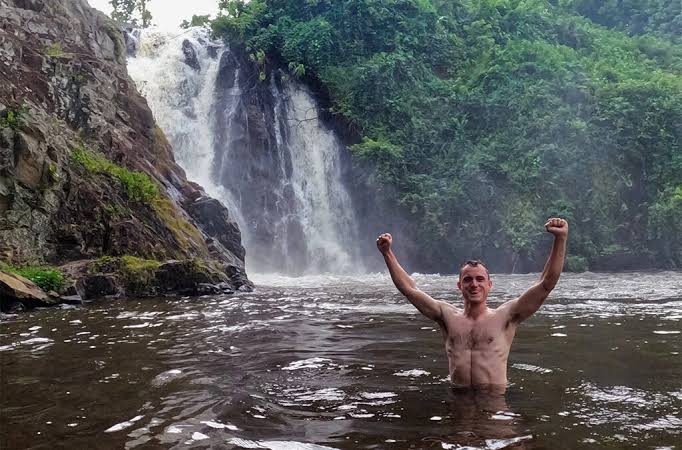
Physically, Sezibwa Falls forms where the Sezibwa River, a roughly 150-kilometer waterway flowing between Lake Victoria and Lake Kyoga, forces itself through hard granite rock outcrops, creating a striking seven-metre cascade accompanied by a distinctive, gentle hissing sound as the water falls.
The surrounding landscape spans roughly seven square kilometers of protected riverine forest, rocky outcrops, and wetland, characterized by massive tropical hardwood trees, lush ferns, and medicinal plants considered by local tradition to hold genuine ancestral significance.
Nature and Wildlife
Beyond its cultural significance, Sezibwa supports worthwhile birding, with numerous species recorded across the site’s forest and rocky terrain, alongside occasional primate sightings adding a further wildlife dimension to what might otherwise be treated purely as a cultural or historical stop.
The site’s genuine natural beauty, a canopy of green trees, weathered rock formations, and the falls’ own cascading water, has increasingly transformed Sezibwa from a purely spiritual destination into a popular nature and adventure stop in its own right.
Activities: More Than Sightseeing
A guided trail allows visitors to walk or hike to the top of the falls and across the water before it cascades down the seven-meter drop, and swimming in the stream is possible for visitors wanting to cool off, with some adventurous guests choosing to jump from the clifftop into the pool below.
The site’s dramatically rocky terrain also supports genuine rock climbing for visitors seeking a physical challenge alongside the cultural and natural sightseeing.
Beyond the falls themselves, Sezibwa offers camping, guided nature walks, birdwatching, boat rides or canoeing, community walks, mountain biking, and primate walks, a comprehensive activity menu for a site so close to Kampala, and most operators offer these as customizable, tailor-made packages for either private or group visits.
Why This Belongs on an Eastern Uganda Route
Sezibwa’s location directly on the standard Kampala-Jinja highway makes it a natural stop for travelers heading toward Jinja’s adventure sports scene, the source of the Nile, or further east toward Sipi Falls and Mount Elgon National Park.
Rather than requiring a dedicated separate trip, Sezibwa functions perfectly as a brief, worthwhile break along a route many travelers are already taking, adding genuine cultural depth to what might otherwise be a purely transit-focused drive.
Getting There
From Kampala, travel roughly 30 to 35 kilometers along the Kampala-Jinja highway, branching off the main road at a small town called Kayanja (or via the specific 1.5-kilometre turn-off cited by other sources), well signposted given the site’s status as an established Buganda heritage attraction. The journey takes roughly 45 minutes to an hour depending on traffic, making Sezibwa feasible as a half-day excursion from either Kampala or Entebbe.
Approaching the Site With Genuine Respect
Given Sezibwa’s status as an active spiritual site rather than a purely secular tourist attraction, visitors are encouraged to approach the shrines and ritual areas with appropriate respect, following your guide’s specific guidance on where photography is appropriate and how to conduct yourself around active ceremonial spaces.
Local custom also holds that throwing a stone into the water brings good luck, a small, low-effort gesture many visitors choose to participate in as a way of engaging with the site’s living tradition rather than observing it purely from a distance.
Frequently Asked Questions
What is the legend behind Sezibwa Falls?
According to Buganda tradition, a woman named Nakangu Tebatuusa gave birth to twin rivers, Bwanda and Sezibwa, rather than human children. Sezibwa’s name derives from a Luganda phrase meaning “my path cannot be blocked,” reflecting the obstacles the river overcame in the myth.
Is Sezibwa Falls still an active spiritual site today?
Yes, traditional healers continue to perform ceremonies here for visitors seeking blessings, and numerous shrines, including the Nalongo Ya Sezibwa shrine, remain active around the falls.
How far is Sezibwa Falls from Kampala?
Roughly 30 to 35 kilometres, about 45 minutes to an hour by road along the Kampala-Jinja highway, making it a accessible half-day trip from either Kampala or Entebbe.
What activities are available at Sezibwa Falls?
Hiking to the top of the falls, swimming, rock climbing, birdwatching, camping, canoeing, community walks, mountain biking, and guided nature and primate walks, alongside the site’s core cultural and historical significance.
Can I combine Sezibwa Falls with a trip to Jinja?
Yes, very naturally. The falls sit directly on the standard Kampala-Jinja highway route, making them a convenient stop for travelers heading toward Jinja’s adventure sports scene or further east toward Sipi Falls.