Tree Climbing Lions in Ishasha Sector
Ishasha sector lies in the far southern part of Queen Elizabeth National Park, close to the Democratic Republic of Congo border, roughly 110 kilometres and two to three hours by road from Mweya, the sector most closely associated with the rest of the park.
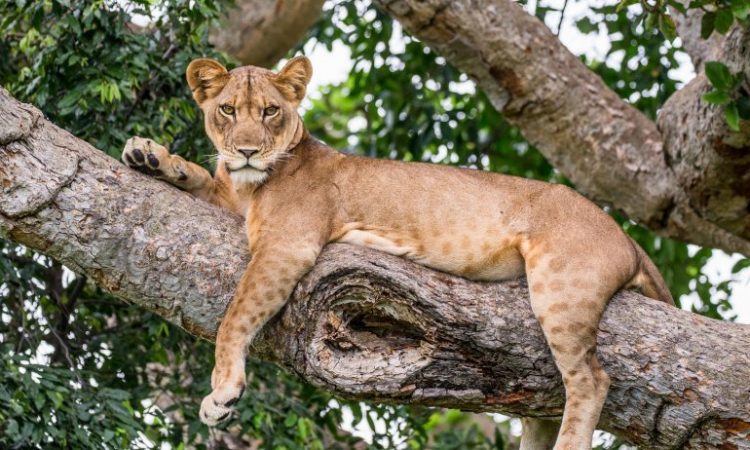
Why Do Ishasha’s Lions Climb Trees?
Scientists haven’t reached full consensus on a single explanation, and several genuine theories exist alongside one another rather than one definitive answer.
The most commonly cited theory involves relief from ground-level heat, tree branches catch cooler breezes and offer shade during the hottest hours of the day, when ground temperatures in Ishasha’s open savanna can become uncomfortable.
A second, closely related theory points to biting insects: frequent climbing may help lions escape ground-level tsetse flies and mosquitoes that become particularly troublesome during certain seasons.
A third theory centres on hunting strategy: from an elevated branch, lions gain a superior vantage point for spotting prey, particularly Uganda kob, across Ishasha’s tall grass and open terrain, potentially explaining why the behavior persists even outside the hottest months.
Finally, some researchers believe the behavior is passed down through generations within specific prides, a learned, territorial habit distinct to this population rather than a universal lion adaptation, which would explain why Ishasha’s lions climb more consistently and reliably than the only other well-documented tree-climbing population, found in Tanzania’s Lake Manyara National Park.
When to Look:
Ishasha’s tree-climbing behavior breaks a standard safari rule of thumb. Where most predator sightings favor dawn and dusk, when temperatures are cool and animals are active, Ishasha’s lions often climb specifically during the hottest part of the day, precisely when the heat-avoidance theory would predict.
That said, early morning and late afternoon remain strong viewing windows too, catching lions either settling into the trees for the day or descending as temperatures cool toward evening, and dedicated searches often run across multiple sessions to maximize the chance of a sighting.
Seasonally, the dry months, June through September and December through February, offer the best overall odds: thinner vegetation makes spotting a resting lion in a tree considerably easier, roads remain passable throughout the sector, and the heat itself may drive more consistent tree-climbing behavior during these specific months.
How the Search Actually Works
Finding tree-climbing lions is a patient, methodical process rather than a guaranteed sighting. Experienced driver-guides move slowly through Ishasha’s game tracks, scanning tree by tree across the sector’s scattered fig and acacia clusters, since guides who work this specific sector regularly develop real, detailed knowledge of which trees particular prides favour. Searches can run for as many hours as your itinerary allows, and even without a lion sighting, the process reveals plenty of other Ishasha wildlife along the way.
Because sightings are never guaranteed, allocating a full day, or ideally an overnight stay, allowing both an evening and morning search, meaningfully improves your odds compared with a rushed single drive-through en route to somewhere else.
Beyond the Lions: What Else Ishasha Offers
Ishasha’s open savanna, riverine landscapes, and relative remoteness support a rich wildlife community beyond its famous predators: large herds of Uganda kob (the lions’ primary prey here), elephant, buffalo, topi, giant forest hog, hippo, and a strong range of birdlife, alongside the sector’s own hyena population.
This diversity means a day spent searching for tree-climbing lions rarely feels wasted even on the occasions a sighting doesn’t materialize, since the surrounding wildlife and scenery reward the visit regardless.
Where Ishasha Fits Within Queen Elizabeth National Park
Ishasha’s genuine remoteness, roughly two to three hours from Mweya’s more developed northern sector, means it operates almost as its own distinct destination within the wider park, considerably quieter and less crowded than the Kazinga Channel or Kasenyi Plains areas.
This isolation is precisely why the tree-climbing lion sightings feel rewarding rather than staged: you’re covering real ground, searching real terrain, for an experience that considerably fewer visitors bother to pursue given the extra distance involved.

The Natural Bwindi Connection
Ishasha sits directly along the standard road route connecting Queen Elizabeth National Park and Bwindi Impenetrable National Park, making it a natural, low-effort addition for the many travelers already combining gorilla trekking with savanna wildlife on a single Uganda itinerary.
Most seven-to-ten-day combined itineraries build in a dedicated half-day or full day specifically for Ishasha as part of this transition, rather than treating it as a separate destination requiring its own dedicated trip.
Where to Stay
Ishasha Wilderness Camp remains the standout accommodation choice directly within the sector, positioned specifically to allow both evening and early-morning lion searches without a long transfer, a genuine advantage over basing from further afield.
Given the sector’s limited overall accommodation compared with Mweya’s more developed lodge scene, booking ahead matters more here, particularly during peak dry-season months when demand for both permits and rooms across the wider Bwindi-Queen Elizabeth corridor intensifies.
Frequently Asked Questions
Why do Ishasha’s lions climb trees when most lions don’t?
No single confirmed explanation exists, but leading theories include escaping ground-level heat and biting insects, gaining a better vantage point for spotting prey, and a learned, generational behavior specific to this particular population.
Is Ishasha the only place to see tree-climbing lions?
It’s the most reliable location in the world for this behavior. The only other well-documented population is in Tanzania’s Lake Manyara National Park, though Ishasha’s lions are generally considered more consistently arboreal.
What is the best time of day to see tree-climbing lions?
Unusually, the middle of the day often works well here given the heat-avoidance theory, alongside the more typical early morning and late afternoon windows favoured for most safari wildlife viewing.
How far is Ishasha from the rest of Queen Elizabeth National Park?
Roughly 110 kilometers and two to three hours by road from Mweya, the park’s more developed northern sector, reflecting Ishasha’s genuine remoteness within the wider protected area.
Can I combine Ishasha with gorilla trekking in Bwindi?
Yes, very naturally. Ishasha sits directly on the standard road route between Queen Elizabeth National Park and Bwindi, making it a common, low-effort addition to combined gorilla-and-savanna Uganda itineraries.