Semuliki National Park offers a distinct proposition among Uganda’s protected areas: it’s the only park in the country composed primarily of true tropical lowland rainforest, a direct eastern extension of the Democratic Republic of Congo’s vast Ituri Forest, and it holds bird and plant species found nowhere else in Uganda specifically because of that Central African connection.
This guide walks through what makes Semuliki different from Uganda’s more famous montane and savanna parks, its hot springs, its Congo-Guinea biome birdlife, and the two distinct indigenous communities whose history is inseparable from the park’s own.
Located in Uganda‘s Western Rift Valley near the town of Fort Portal, Semuliki sits in dramatic, deliberate contrast to the rugged, high-altitude Rwenzori Mountains rising immediately nearby, flat, dense, and humid where the Rwenzori are steep and cool.
A Genuine Extension of the Congo Basin
Semuliki’s forest has been accumulating species for over 25,000 years, and its position as an eastern arm of the Ituri Forest, which stretches deep into the Democratic Republic of Congo toward the Congo River itself, means the park hosts roughly half the bird species found in DR Congo, species that have moved eastward along this specific forest corridor and established themselves nowhere else in Uganda. This rare biogeography is precisely why Semuliki draws such a dedicated following among serious birders specifically, offering access to Congo-Guinea biome species otherwise requiring a trip considerably further west on the continent.
The Sempaya Hot Springs
The park’s best-known attraction, the Sempaya hot springs, comprises two distinct springs, a male spring, known locally as Bintente, and a female spring called Nyasimbi, bubbling up from depths shaped by the same powerful subterranean forces that have driven the wider rift valley’s formation over the past 14 million years. Reaching the springs typically involves an eight-kilometer round trip along the Sempaya Nature Trail, offering strong birding and primate viewing along the way, and the springs themselves are hot enough that local guides traditionally use them to boil eggs and cassava as a memorable demonstration for visitors.
The Kirumia Trail
The Kirumia Trail, a 13-kilometer route running through the heart of the forest to the Semuliki River itself, offers an eight-hour round trip beginning at 8am and stands as the park’s premier route for serious birders and primate trackers. The river corridor here attracts rich wildlife activity, and the trail’s considerable length rewards patient, unhurried walkers over those wanting a quick sample of the forest.
The Red Monkey Track
An 11-kilometer route following the park’s eastern border to the Semliki River, the Red Monkey Track takes its name from its status as a genuine stronghold for the rare De Brazza’s monkey, a species with a distinctive white beard and orange-red crown found in only a handful of locations across Uganda. This trail offers a considerably different wildlife focus from Kirumia’s broader birding emphasis, worth prioritizing specifically for travelers hoping to encounter this particular primate.
Birding
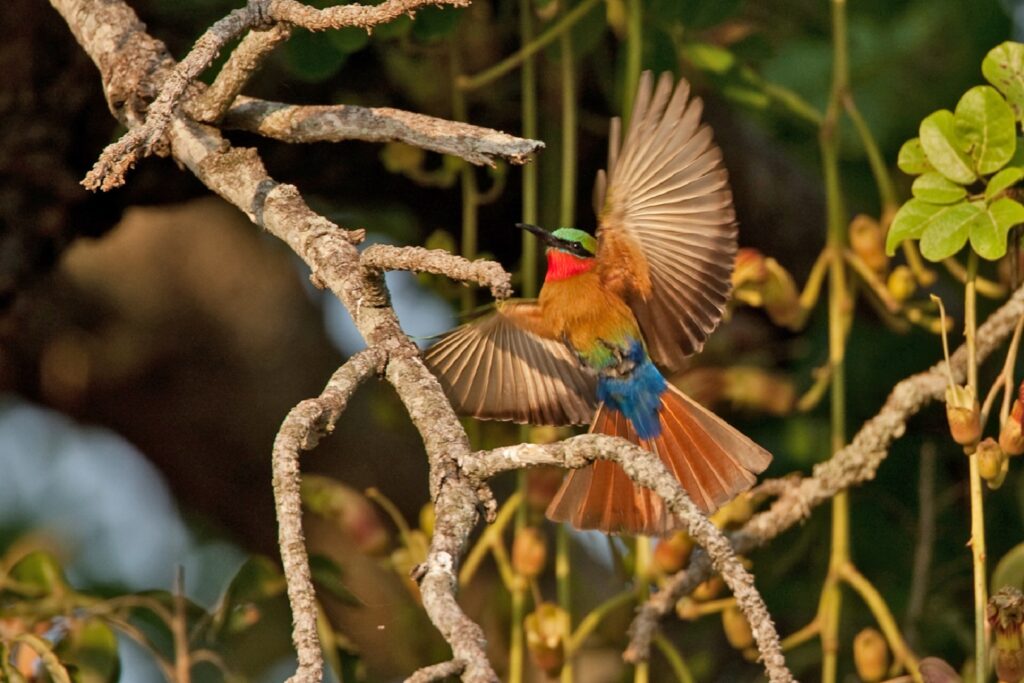
With somewhere between 400 and 444 recorded bird species depending on the specific count, Semuliki stands among Uganda’s premier birding destinations, and its Congo-Guinea biome specialties can’t be found reliably anywhere else in the country: piping hornbill, white-crested hornbill, Congo serpent eagle, spot-breasted ibis, red-thighed sparrowhawk, forest ground thrush, and Nkulengu rail among the standout targets. The best birding areas within the park are Ntandi and Sempaya, both offering strong sightings of the region’s turaco species, including the great blue turaco and Ross’s turaco, while the Kirumia River corridor and areas near Lake Albert occasionally reward patient birders with the prehistoric-looking shoebill stork.
Wildlife Beyond the Birds
Semuliki holds 53 recorded mammal species, including forest elephant, buffalo, leopard, and eight primate species, chimpanzee, black-and-white colobus, and De Brazza’s monkey, among the most notable. The park is also home to pygmy hippopotamus, though sightings are rare given the species’ elusive nature, and forest elephants here differ meaningfully in size and behavior from the savanna elephants found elsewhere in Uganda, generally smaller and considerably more difficult to spot given the forest’s dense cover.
The adjacent Toro-Semliki Wildlife Reserve, a separate but complementary protected area, offers three tracks crossing open savanna grassland, delivering a different wildlife experience within the same broader region: buffalo, waterbuck, crocodile, warthog, and Uganda kob across open terrain, alongside night game drives revealing nocturnal species including the white-tailed mongoose.
The Batwa and Basua
Semuliki’s human history is layered and complex. The Batwa, forest-dwelling pygmy people who lived in the Semuliki forest for millennia, have been resettled, with support from Christian aid organizations, in an area near Ntandi, though many continue to describe a genuine, ongoing longing for their previous forest way of life. With support from the Uganda Wildlife Authority, some Batwa community members now share their cultural heritage directly with visitors through dance, storytelling, and craft demonstrations, offering genuine, community-led cultural engagement.
A second, distinct group, the Basua, who are also pygmy and have a historical connection to the Ituri Forest, have faced more recent eviction from parts of the park and have struggled much more than the Batwa to adapt to life outside the forest, raising real concerns about how this displacement will affect their culture’s long-term survival. Understanding this distinction between the two communities, rather than treating Semuliki’s indigenous history as a single undifferentiated story, matters for anyone engaging with the cultural dimension of a park visit.
Entrance Fees
Park entrance costs $40 per person per day for foreign non-residents, $30 for foreign residents, and UGX 20,000 for East African citizens, with children charged $5 regardless of residency status and UGX 2,500 for East African children. Vehicle entry adds a further UGX 45,000, and these fees are collected by the Uganda Wildlife Authority to fund both park management and the surrounding community programs.
Quick-Reference Trail Comparison
| Trail | Distance | Focus |
| Sempaya Nature Trail | ~8 km round trip | Hot springs, birding, primates |
| Kirumia Trail | 13 km, ~8-hour round trip | Serious birding, primate tracking, river corridor |
| Red Monkey Track | 11 km along the eastern border | De Brazza’s monkey stronghold |
How Semuliki Compares to Uganda’s Other Forest Parks
Where Bwindi and Kibale offer montane and mid-altitude rainforest with their own distinct primate specialties, Semuliki is Uganda’s only true lowland tropical rainforest park, flat, dense, and humid, with a bird and plant community shaped by Central African biogeography rather than the East African Albertine Rift patterns dominating the country’s other forest destinations. This makes Semuliki a worthwhile addition, rather than a substitute, for travelers who’ve already covered Uganda’s primate-trekking circuit and want a meaningfully different forest ecosystem within the same broader region.
Getting There
Semuliki sits close to Fort Portal in western Uganda, making it a natural, efficient addition to an itinerary already including Kibale National Park’s chimpanzee trekking, given the short transfer distance between the two. Road access from Fort Portal takes roughly two hours, and the park pairs particularly well with a Rwenzori Mountains stop given their close geographic proximity and striking landscape contrast.
Best Time to Visit
Semuliki rewards visits year-round given its lowland, relatively stable climate, though the dry seasons, December through February and June through August, offer firmer trail conditions for the longer Kirumia and Red Monkey routes specifically. Birding remains rewarding throughout the year, since the park’s resident Congo-Guinea biome specialists don’t follow the same seasonal migration patterns that affect birding elsewhere in Uganda.
Where to Stay
Accommodation directly within Semuliki remains limited given the park’s relatively modest visitor numbers, and most travelers base themselves in nearby Fort Portal or at properties closer to the Rwenzori foothills, making a day trip or short stay at Semuliki a natural addition to a broader western Uganda itinerary rather than a standalone multi-night destination on its own.
Health and Safety Preparation
Semuliki sits within a malaria-risk zone, and given its lowland, humid rainforest setting, standard prophylaxis and consistent insect repellent use matter considerably here. The park’s dense forest cover also means warm, humid conditions throughout most activities, worth factoring into clothing choices and hydration planning regardless of season.
Combining Semuliki With the Rest of Uganda
Semuliki’s proximity to both Kibale National Park and the Rwenzori Mountains makes it an efficient addition to a western Uganda circuit rather than requiring a dedicated separate trip. Many travelers build in a single day at Semuliki specifically for its hot springs and distinctive birding, positioned between a Kibale chimpanzee trek and either a Rwenzori trekking expedition or onward travel toward Queen Elizabeth National Park.
Why Semuliki Rewards a Dedicated Visit Rather Than a Passing Stop
Given its relatively modest size and lower overall profile compared with Uganda’s more famous parks, Semuliki is sometimes treated as a brief detour rather than a genuine destination in its own right, a framing worth reconsidering for travelers with a real interest in birding or forest ecology specifically. The park’s unique Congo Basin character, its Central African bird specialties, and its layered, complex human history make it a destination that rewards unhurried time considerably more than a rushed hour at the hot springs alone would suggest.
Frequently Asked Questions
What makes Semuliki National Park different from Uganda’s other forest parks?
It’s Uganda’s only true lowland tropical rainforest park, a direct eastern extension of DR Congo’s Ituri Forest, giving it bird and plant species found nowhere else in the country due to this specific Central African biogeography.
What are the Sempaya hot springs?
Two distinct hot springs, a male spring (Bintente) and a female spring (Nyasimbi), reached via an eight-kilometer round trip on the Sempaya Nature Trail, hot enough that guides traditionally demonstrate boiling eggs in the water.
Is Semuliki good for birdwatching?
Exceptionally so, with 400 to 444 recorded species, including Congo-Guinea biome specialties like the piping hornbill, Congo serpent eagle, and spot-breasted ibis, found nowhere else in Uganda.
What is the difference between the Batwa and Basua communities at Semuliki?
Both are pygmy peoples with deep historical ties to the forest, but the Batwa were resettled with organized support near Ntandi and now share cultural heritage with visitors, while the Basua faced more recent eviction and have struggled considerably more to adapt, raising ongoing cultural preservation concerns.
How much does it cost to enter Semuliki National Park?
$40 per person per day for foreign non-residents, $30 for foreign residents, and UGX 20,000 for East African citizens, plus a UGX 45,000 vehicle entry fee.